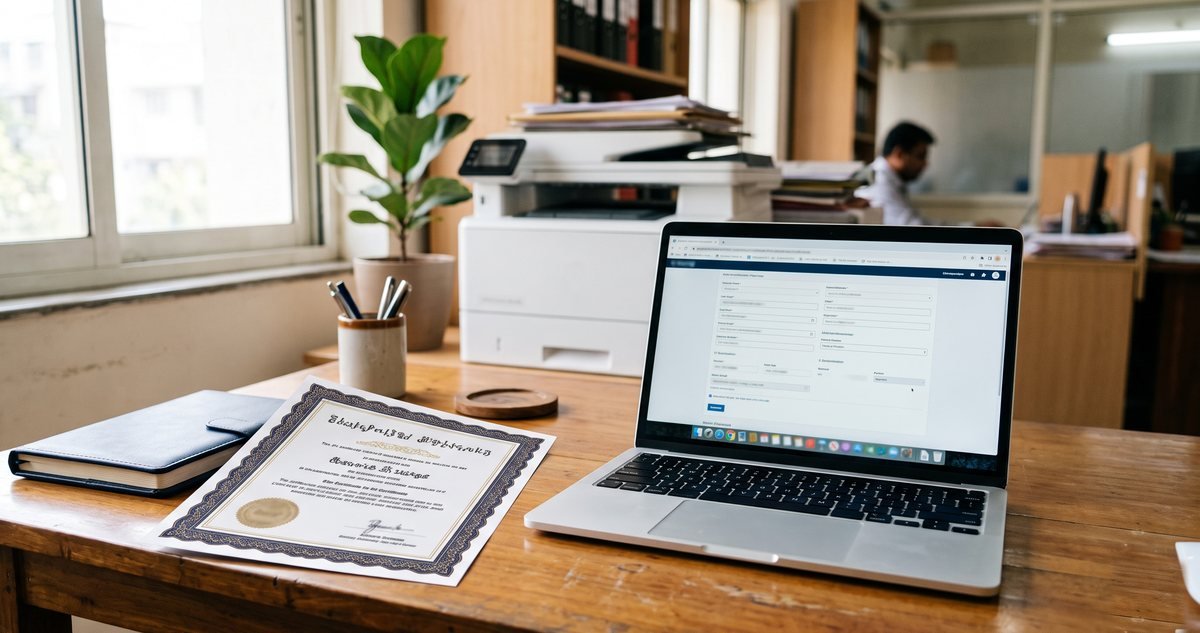
This article is general information about Punjab's e-stamping procedure, not legal advice. Duty rates, portal steps and approved payment channels are set by the Board of Revenue and change from time to time. Confirm current details on the official portal, or ask a lawyer, before relying on any figure here.
For case-specific guidance, speak with our property lawyer in Lahore.
Punjab replaced the old system of buying stamp paper from a licensed vendor with an online process called e-stamping. If you need e-stamp paper in Punjab for a sale agreement, a rent agreement, an affidavit, a power of attorney or any other instrument the law requires to be stamped, you now generate it through a government portal instead of walking into a stamp shop. This guide covers what e-stamp paper is, why Punjab moved to it, and the difference between judicial and non-judicial stamp paper. It also walks through the steps to generate one, which documents need stamping, how to verify a stamp before you rely on it, and the mistakes that cause agreements and registrations to fail.
What E-Stamp Paper in Punjab Is and Why It Replaced Paper Stamps
Stamp duty is a tax on certain documents, charged under the Stamp Act 1899. Before an instrument such as a sale deed, an affidavit or a power of attorney can be relied on or produced as evidence, it generally has to carry stamp paper of the correct value, called the denomination. For decades this meant buying a pre-printed sheet of paper from a licensed stamp vendor and writing or printing the document on it.
Paper stamps had a well-known weakness: a physical sheet is easy to alter, reuse or counterfeit, and a vendor's private stock is hard for a government office to audit in real time. E-stamping addresses this by moving the transaction online. Instead of a vendor selling paper, the Punjab Board of Revenue's e-stamping system generates the stamp electronically once the duty has been calculated and paid through a bank channel, and the resulting document carries a verification number that anyone can check against the official record.
E-stamp paper in Punjab is not a different legal instrument from a traditional one. It still evidences that stamp duty has been paid on your document under the Stamp Act 1899, and it still has to carry the correct denomination for what you are signing. What changed is how you get it: through the Board of Revenue's online system rather than a vendor's counter, with the payment and the record both tied to your CNIC (the national identity card number issued by NADRA).
Judicial vs Non-Judicial Stamp Paper
Not every stamp paper is the same, and using the wrong category is one of the more basic ways a document goes wrong. The law separates stamp paper into two broad categories, and which one you need depends on what the document is for.
- Judicial stamp paper is used for court-related purposes: paying court fees on a plaint or an application, or preparing affidavits and other documents intended for use in a court proceeding.
- Non-judicial stamp paper is used for private legal instruments that are not a court filing: an agreement to sell, a rent or tenancy agreement, a general affidavit, a power of attorney, a gift deed, or a property transfer instrument.
The distinction matters because a document stamped on the wrong category is treated as unstamped or insufficiently stamped for its actual purpose, and that is exactly the kind of defect that surfaces later, when the document is produced in court or at the sub-registrar's office and someone objects to it. A court fee stamp, for instance, does the job of paying the fee attached to a filing; it does not also serve as the stamp on the underlying agreement that filing might rely on. The two purposes are separate, and the paperwork has to reflect that.
Some documents sit close to the line. An affidavit can be sworn purely for a private purpose, such as a statement attached to a bank form, or it can be prepared specifically to be filed in a court proceeding, and the correct stamp paper differs accordingly. The same goes for a power of attorney drafted to be produced before a court versus one used only to authorise a private transaction. If you are not sure which category your document needs, particularly where it might be used both privately and in litigation, ask a lawyer before you generate the stamp rather than after. Re-doing an incorrectly stamped document costs more time than getting it right the first time.
How to Generate an E-Stamp in Punjab, Step by Step
Generating e-stamp paper in Punjab follows the same basic sequence regardless of the instrument you are stamping.
- Go to the Punjab e-Stamping portal. The Board of Revenue runs the official online system for generating e-stamps. Use the current official portal rather than a third-party site, and confirm the address with your bank or a lawyer if you are unsure you have the right one.
- Enter your CNIC and the instrument details. You will be asked for your CNIC number, the type of document (sale agreement, affidavit, power of attorney and so on), the parties involved, and a description of what the document covers.
- Let the system calculate the duty. Based on the document type and the value you declare, the portal works out the stamp duty payable under the current schedule.
- Generate the challan or PSID. The system issues a payment slip, commonly called a PSID (Payment Slip ID) or challan, showing the exact amount due.
- Pay through an approved bank channel. Duty is paid through the designated banking channels linked to the e-stamping system, not in cash to an individual. Keep your payment receipt.
- Receive your e-stamp. Once payment clears, the system generates the e-stamp paper, which carries a unique verification number. Save or print it and attach it to, or use it as the basis of, your document.
If a step produces an error, such as a mismatch between your CNIC details and your national identity record, resolve it through the portal's own support channel or a Board of Revenue office rather than guessing at a workaround.
You do not have to do this yourself. If the underlying document is being prepared by a lawyer, the lawyer or their office can generate the e-stamp as part of drafting the instrument, using the same CNIC and instrument details you would enter yourself. This is useful for a power of attorney or sale agreement where the drafting and the stamping need to line up exactly, since a mismatch between what the e-stamp says and what the document says is one of the mistakes covered further down. Keep both the digital record and a saved or printed copy of the e-stamp; you may need to produce either one depending on where the document ends up.
What Documents Need Stamp Paper, and How Much
Most instruments that create, transfer or record a legal right or obligation need stamp paper. The common ones include:
- Agreements to sell (immovable property)
- Rent and tenancy agreements
- Affidavits
- Powers of attorney
- Sale deeds and other property transfer instruments
- Mortgage and gift deeds
For rent agreements specifically, see our guide to rent and tenancy law in Punjab for what a valid agreement needs to contain. For property sales, how to transfer property in Punjab covers the registration and mutation steps that follow stamping. Powers of attorney have their own drafting requirements; we cover those separately in power of attorney in Pakistan. If an agreement to sell falls apart later, our guide to recovery of money and specific performance covers the remedies available.
How much duty you pay depends on the type of instrument and, for property and value-based documents, the declared or assessed value. A fixed-purpose document like a general affidavit typically carries a modest, standard denomination. A property instrument, by contrast, is duty-linked to the value of the transaction, so the correct denomination moves with the price you declare, not with a flat figure you can memorise once and reuse.
These rates come from the Stamp Act 1899 schedule as amended from time to time by Punjab's finance legislation, and they change. Rather than quoting a figure that may already be out of date by the time you read this, use the e-Stamping portal's own calculator, which applies the current schedule once you enter your document type and value. If anyone other than the portal or your lawyer quotes you a specific rate, treat it as an estimate, not a guarantee, and confirm it against the portal before you pay. Guessing at the denomination, or reusing a figure a friend or agent quoted from a different transaction, is one of the more common ways people end up under-stamped without realising it.
How to Verify an E-Stamp
Every e-stamp carries a unique verification number, and the Punjab e-Stamping portal lets anyone check a stamp against that number to confirm it is genuine, matches the stated denomination, and has not already been used.
If you are a buyer, a tenant, or anyone about to sign a document that relies on someone else's stamp paper, verify it before you sign rather than after. Check that the denomination matches what the transaction requires, that the names on the stamp match the parties to the document, and that the stated purpose matches what you are doing. It takes a few minutes and closes off one of the more common sources of dispute later.
Older paper stamps carried a real forgery risk because there was no central record to check them against. A genuine e-stamp does not have that problem, but a photocopy or a screenshot of one does, since it strips out the features that let the portal confirm authenticity. Always work from the original e-stamp record, not a copy of it.
If a stamp fails to verify, whether the number does not match, the record shows a different denomination, or the portal cannot find it at all, treat that as a reason to stop, not a minor glitch. Ask the other party to produce the original e-stamp again or generate a fresh one, and do not proceed to sign or register the document until the discrepancy is explained. For a property purchase in particular, this check is worth doing alongside the other title and ownership checks your lawyer runs before you commit to the transaction.
E-Stamp Mistakes That Break Transactions
A stamp paper that looks fine on the surface can still sink a transaction or a court filing later. The mistakes we see most often are avoidable, and the same handful keep turning up on files that otherwise have nothing in common with each other.
Wrong denomination or under-stamping. If the stamp value is lower than what your document requires, given its type and declared value, the instrument is treated as insufficiently stamped. Under the Stamp Act 1899, an insufficiently stamped document can be impounded (seized and held by the authority examining it) and penalised when it is produced before an authority, and it may not be admitted as evidence until the deficiency is made good.
Wrong purpose entered. Generating the e-stamp for one type of document and then using it for another, for example generating it for a general affidavit and then using it for a power of attorney, creates a mismatch that can be challenged later.
Name or CNIC mismatches. If the name or CNIC on the e-stamp does not match the party signing the document, expect the sub-registrar (the office that registers property deeds), the bank or the other side to question it. This is one of several reasons under-stamping and identity mismatches surface at the property registration stage; see our guide on how to transfer property in Punjab for what the sub-registrar checks before registering a deed.
Using a photocopied or screenshotted stamp. As above, a copy cannot be verified the same way the original can, and a counterparty or an official is entitled to reject it outright.
None of these mistakes require bad faith. They usually happen because someone filled in the portal form quickly, or because whoever drafted the underlying document was not the same person who generated the stamp. A deed drafted by a lawyer but stamped by a client acting alone, or the other way round, is a common way for the two to drift apart.
The fix for all of them is the same: generate the e-stamp only once the document it belongs to is in near-final form, so the type, value, and parties entered on the portal match what the document says. Checking this before signing costs a few minutes. Discovering the mismatch after a dispute has already started costs a great deal more.
When to Involve a Lawyer
Generating an e-stamp is a form-filling exercise. Drafting the document that goes on it is not, and that difference is where most of the actual risk sits.
The stamp paper itself only carries evidence that duty has been paid. Whether the underlying agreement to sell, affidavit or power of attorney actually protects you, states the right value, names the right parties and holds up if it is challenged later depends on how it was drafted. A correctly generated e-stamp attached to a badly drafted instrument does not fix the instrument.
A lawyer is most useful before you generate the stamp, not after: to confirm which category and denomination your document needs, to draft or review the instrument itself, and to check that the details entered on the e-stamp (parties, purpose, value) match what the document says. This matters most for property sale agreements, powers of attorney used by someone acting on your behalf, and any instrument you expect to rely on in a dispute. In our experience, the files that resurface months later are usually the ones where the e-stamp was generated before the document itself was in final form.
It also matters when you are on the receiving end of someone else's document, not just when you are the one generating the stamp. A buyer reviewing a seller's agreement, a tenant reviewing a landlord's tenancy agreement, or anyone asked to sign against a power of attorney they did not draft should have a property lawyer in Lahore check both the stamp and the underlying terms before they sign. Catching a problem at that stage is straightforward. Unwinding it after the fact, once money or possession has changed hands, is not. The requests we get for a second look most often come from the side that did not draft the document in the first place.
Speak to a Property Lawyer in Lahore
If you are preparing an agreement, affidavit or power of attorney and want the stamping and the drafting handled correctly together, Saeed Law Firm has practised in Lahore since 1975 and offers a free initial consultation. Contact us or call +92-319-4959420.
Saeed Law Firm, Y Block Main Market, Sector Y, DHA Phase 3, Lahore 54793. Phone: +92-319-4959420.